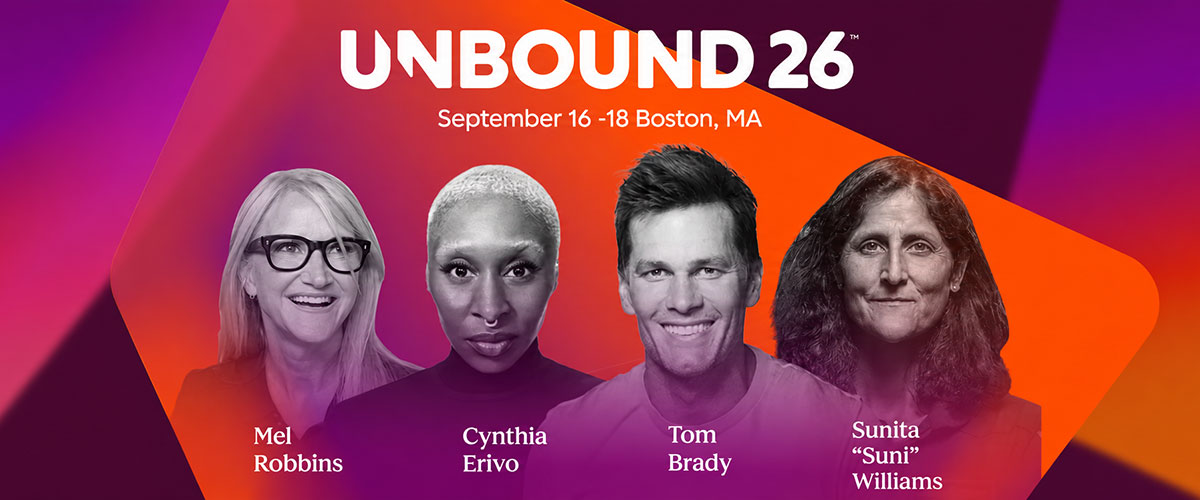
As a HubSpot partner, our team made it to Boston for UNBOUND 2026, where more than 13,000 marketers, creators and business leaders gathered to explore where AI is taking marketing next.
AI dominated the conversation, but one theme stood out: technology is getting better at understanding who your customer is. Connecting with them is still a human job.
Astronaut Suni Williams helped put that idea into perspective. Her experience in space showed what happens when circumstances change, and the expected solution is no longer available. Technology matters, but solving an unexpected problem still requires people who can communicate, adapt, and make decisions.
That same idea kept resurfacing throughout UNBOUND, but in a much different context. Here are three themes that stood out for marketers.
Human Content Is Winning
As AI makes it easier to create more content, sounding like everyone else becomes a bigger problem.
In “Do This, Not That: Fastest Lifts in Content, Offers & AI,” Jay Schwedelson encouraged marketers to deliberately “un-AI” their content by moving away from predictable language and adding specific observations, opinions and details across channels like email and social.
Beth Dunn’s “Why Weird Works” took that idea even further. She argued that marketers were starting to sound alike long before AI. AI is accelerating the problem.
Dunn pointed to research around Italy’s temporary ChatGPT ban in 2023. According to the research she presented, when restaurants in Milan suddenly lost access to the tool, their social posts became less similar, posting frequency dropped and engagement increased roughly 5% to 7%. Without the same tool to fall back on, marketers had to improvise, and their content became more distinct.
Dunn emphasized that distinctiveness works when it targets the right audience. Brands need to be memorable to the people they’re trying to reach. Her session also explored how being distinctive becomes more effective when paired with competence and warmth.
Behind the Scenes Beats Overproduction
That same thinking showed up in Schwedelson’s recommendations for video.
Behind-the-scenes footage, hallway walk-and-talks and less polished video can make brands feel more immediate and alive. His presentation highlighted research showing walking selfie videos generating 49% higher completion rates on LinkedIn.
Quality and polish are different, and the strongest content often prioritizes the former.
Sometimes showing the person behind the brand is the stronger creative choice.
AI Is Changing How Content Gets Found
AI is also reshaping how content gets discovered.
One of Schwedelson’s recommendations was to pay closer attention to recency. His presentation cited research showing that AI citations average 393 days newer than traditional Google search results and that content with a clearly identified recent date or time period is more likely to appear in large language model results. For SEO teams, the idea of keeping valuable content fresh should sound familiar.
Freshness Needs to Be Visible
That can mean something as simple as changing “The State of HR Laws” to “The State of HR Laws: Q3 2026,” or including language like “As of August 2026” and “Based on 2026 data.” The important part is making sure the content behind that date is actually current.
Older assets can also be updated and relaunched with fresh context. That’s a proven SEO tactic that beats starting from scratch. At LP, we’ve recommended auditing and refreshing outdated content as part of our SEO and content strategy for years. AI search is giving marketers another reason to prioritize it.
Schwedelson also pushed marketers to reconsider where content ideas come from. He recommended building content around a simple question: “What do our prospects and customers care about?”–another concept SEO teams should recognize. Understanding what people search for, what they need to know and what helps them make a decision has long shaped keyword and content strategy.
AI gives marketers another way to uncover the questions customers are actually asking across discovery, pricing, comparisons, objections and purchase decisions. It adds another layer to the audience research and keyword research marketing teams use to understand what people want to know. That creates an opportunity to use AI as a listening tool before using it as a creation tool.
Better Tools Should Raise the Creative Bar
That theme carried into Grant Lee’s “Making Ideas Matter: Communication in the AI Age.”
One of the session’s central ideas was to “make people curious before making them informed.”
When AI can produce enormous amounts of information almost instantly, the advantage shifts to earning someone’s attention and giving them a reason to care about what comes next.
Lee’s session focused on how ideas are communicated and sequenced, reinforcing the importance of storytelling even as the tools used to create that story change.
That same idea surfaced in a session on AI tools for creative teams with Runway co-founder Alejandro Matamala-Ortiz. Generative video has advanced to the point where many of the individual components needed to create a feature-length film now exist. Runway deliberately builds tools that let artists iterate and maintain creative control throughout the process.
Faster execution should raise the creative bar.
The opportunity is to spend more time on the idea itself: Is it interesting? Does it feel like us? Will someone care? Is there a better way to tell the story?
The technology can help execute an idea. Someone still has to recognize whether the idea is worth executing.
The Technology Is Taking Off. The Human Part Keeps Us Grounded.
That brings the conversation back to Suni Williams. Spaceflight and marketing carry very different stakes, and the parallel still holds.
We build increasingly sophisticated technology to help us understand and solve problems. Then reality changes. Something unexpected happens. The data isn’t perfect. The customer behaves differently than predicted. The creative doesn’t connect.
At that point, technology is only part of the solution.
That thread ran through UNBOUND. AI can help brands better understand who their customers are and what they care about. It can help us find information, uncover opportunities and bring ideas to life faster.
How we talk to people, take care of them and creatively connect with them still relies on the human in all of us.
The tools will keep evolving. The human part is what gives them direction and meaning.
Ready to pair AI-driven insights with content that sounds like your brand? Let’s talk about what that could look like for your team.