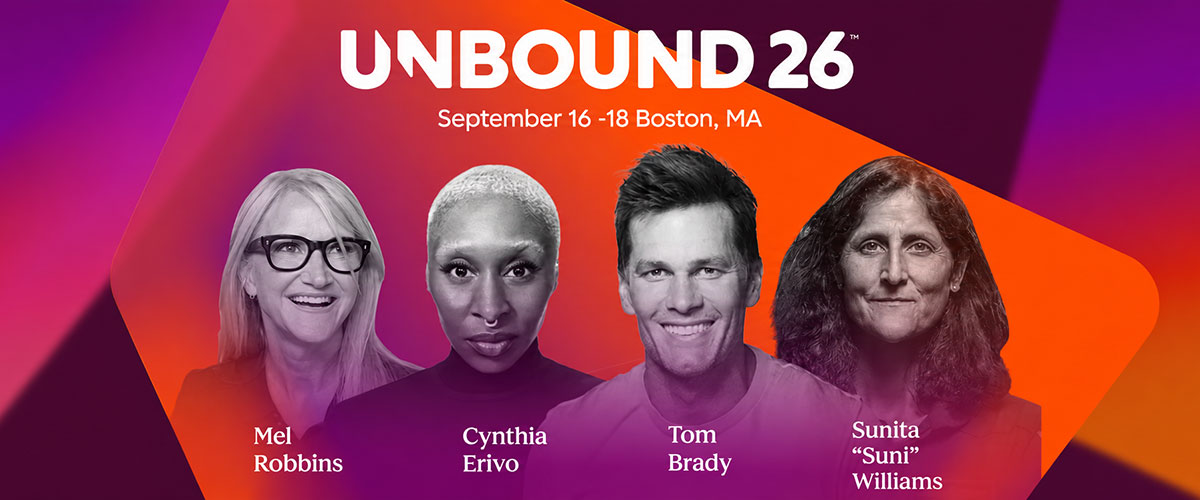
In September of 2026, two large conferences took place in Boston, and I was fortunate to attend both. The first was K:Bos, an event hosted by Klaviyo, and the second was Unbound, HubSpot’s rebrand from the previously titled Inbound. Both companies carry clear distinctions: HubSpot was a CRM first and excels at B2B and lead generation. Klaviyo was an ESP (Email Service Provider) first and favors e-commerce (see their latest tagline, which positions them as the only B2C CRM built for e-commerce brands).
While the platforms have different missions, there were several common threads between the two conferences. Both, of course, had celebrity speakers. Both discussed massive improvements to their helpdesk features and advancements in their AI products, as well as a variety of answers to the question “what’s next?” Outside of specific product demos and announcements, there were conversations and insights that were platform-agnostic, brought into a buzzing pool of diverse minds. In this blog, I compare insights pulled from the two events and how they cast their own pictures on the past, present, and future of digital marketing and the consumers at its center.
The Evolution: Breezy Composition
As mentioned, much of the conferences’ panel time was devoted to unveiling new features and how best to use them. For the daily users and marketing professionals, this is where the most practical information comes to light. We have the opportunity to see what’s new straight from the ones who built it and begin testing before other brands catch on. For example, the ability to ask questions about Klaviyo Helpdesk from one of the actual engineers of the product is far more effective than a queue of online support tickets.
Comparisons can be made between two of the big features that were focused on at both events, as both Klaviyo and HubSpot continue to push their platforms as a single-solution tool. This includes advanced AI capabilities and data-rich evolutions in customer service.
AI Tools: Breeze and Composition
Both conferences discussed notable updates to their AI tools. Klaviyo revamped Composer while HubSpot turned up the spotlight on Breeze for content creation. Beyond the biggest distinction between the two—one focusing predominantly on lead generation and the other on e-commerce—there are still a few notable differences in how they’re applied.
| Feature | HubSpot Breeze Studio | Klaviyo Composer |
|---|---|---|
| What it is | Agents do work autonomously; Assistants are on-demand experts with business context | “Always-on marketing expert” that finds opportunities and acts, not just a prompt-and-wait tool |
| Instructing it | Extra Instructions, set once per agent | Composer Skills save reusable brand context |
| Action layer | 50+ tools, plus MCP servers (Asana, Notion, Zapier, Atlassian) | Headless: 260+ MCP tools, callable from Claude or ChatGPT |
| Getting started | Pre-built agents install in seconds from a marketplace | Surfaces opportunities on its own |
| Automation | Triggers off business events, like a workflow | Scheduled recurring audits, e.g. monthly summaries |
Agent vs. Agent
Both Klaviyo and HubSpot unveiled updates to their customer agent capabilities that revolutionize not only automated customer service, but how one-time tickets or reservations can roll into increasing personalization and lifetime value with minimal human interactions. Voice agents that can identify and log customer properties or open tickets have been demonstrated at both events. Below are some comparisons of what attendees saw:
| Feature | HubSpot Customer Agent | Klaviyo Customer Agent |
|---|---|---|
| Trained on | Knowledge base, website, past conversations, guidelines | Brand knowledge base from storefront or integrations |
| Actions | External-system actions; demo updated address, upgraded plan, booked tune-up | Modifies subscriptions, processes returns, books reservations |
| Channels | Ticketing/chat, plus phone via Customer Agent Voice (public beta) | Chat, email, SMS, WhatsApp, voice, 100+ languages |
| Setup | Breeze configures knowledge, guidelines, behavior, handoff rules; batch testing | Pre-trained on your data, auto-configured; Composer adjusts it in plain language |
| Handoff | Logs a summary automatically in Help Desk before handing off | Demo case resolved end-to-end with no handoff needed |
Choosing Your Application
We can list out similarities and differences, but what do they actually mean for marketers and business professionals? There are a few essential items to consider:
- What’s your current tech stack? The last thing you want to do is rewrite your entire tech stack based on a single decision. If you’re already using HubSpot as your CRM or for project management, it may make sense to keep your tools in the same space. If you have integration needs that are difficult to support, Klaviyo may offer more options.
- What’s your business model? Consider your audience and the applications. An audience for a high-ticket product or service that has several touchpoints and custom properties would find it simple to feed those journeys into HubSpot’s Help Desk or Customer Agent Voice. A business that’s a blend of a brick-and-mortar location(s) and an online e-commerce store may find Klaviyo’s Voice Agent abilities a great way to connect calls made to your store to online traffic and revenue.
- What are your best channels? Consider which channels are your most valuable ones and compare the AI platform features. Brands with strict creative branding guidelines and mobile users may get the most out of Klaviyo’s AI abilities. Brands that really focus on onsite conversions and SEO may find HubSpot’s features more suitable.
Note that there are many times when the best application is a blend of several platforms. There will be businesses that find a strong integration between the two platforms (in addition to the rest of their tech stack) is what creates the perfect cocktail for themselves and their audience.
The Present Pivot: On AI
If you go to any conference, webinar, or business class, AI will become a part of the conversation. AI isn’t only the biggest thing since sliced bread; it can tell us dozens of different ways to slice the bread in about 1.7 seconds of thinking time. My head and my search history have been buzzing with AI since K:Bos 2025 unveiled the release of K:AI and discussed the upcoming Claude MCP. As one could expect, K:Bos and Unbound both had a lot to say about AI in 2026.
Above, I of course mentioned the comparisons between the two platforms’ AI features. Naturally, however, the AI conversations went far beyond just “What can AI do?” It was also, “What should AI do?” and “What could AI do?”. The answer is, of course, a lot. Klaviyo showed us how booking an anniversary dinner with an AI voice agent could trigger a personalized automated email a year later. On the exhibition floors at both conferences, professionals who were strangers five minutes before huddled with their laptops around tables and swapped notes. The majority of the people I talked to had at least a few Claude MCP connectors running and had completely delegated note-taking to AI agents. Since the 2025 convention scene, it’s quickly crossed the bridge from something to introduce to an essential piece of the tech stack. Although the minds and opinions of attendees and speakers were diverse, this opinion seemed to be near unanimous.
AI, many speakers reminded us, gives us time to pursue innovation that is otherwise lost. Sometimes staring at a wall and thinking through a task will lead to a bigger breakthrough than trying to manually summarize the dozen cold emails sitting in your Outlook.
AI is useful, but only when brands consider how they’re utilizing AI and the fact that our customers are also utilizing it. One Unbound panel drew attention to a viral video where a user was able to make a company’s customer service chatbot talk badly about the company, including writing a poem about how bad the company was. A speaker at a K:Bos panel said that 20% of purchases this holiday season are expected to be products surfaced by AI recommendations. In our HubSpot recap blog, we dive more into the specific insights shared in panels.
A stat shared at Unbound was that of the 90% of businesses that say they use AI, only 6% use it effectively. Don’t be a part of the 90% until you’re confident that you can be a part of the 6%.
The Future: Still Human… And then Some
There was another common thread brought up by more than one person among the dozens I’ve seen speak in the last two weeks: people love brands.
When they’re loyal, they want to hold onto that loyalty. Those 20% of consumers I mentioned who will do their holiday shopping via AI suggestions aren’t bots, but humans looking for solutions. So, how do we pivot to meet those needs? Mel Robbins said that if you’ve served one person, you’ve done your job. They’ll reconnect and share. They’ll give out the referral code for their discount, and they’ll leave the review that the GPT later picks up.
Every day, thousands of humans have a brilliant idea. This is apparent when you’re in a massive hall where you feel like the literal electricity in the building is powered by all the people there who have ideas. The people who dare to act on those ideas are the ones who demand excellence and discover something when everyone else thought there was nothing left to discover.
At Unbound, many speakers brought up photography and how, when the camera entered the mainstream, people feared the centuries-long career of portrait art would disappear. And sure, thanks to the iPhone, we don’t need to hire someone to paint our portrait before we go on a date. However, that didn’t mean the medium of painting disappeared. It simply evolved through the creatives who understood what it was to create.
Once, when you Googled something, someone may have asked why you didn’t just go to the library. We didn’t because we recognized that the world was changing, and would always change, and that we can be a part of that if we embrace what’s next.
We know that people will always love brands, no matter how the algorithm changes or how we discover them. Over the past two weeks, my colleagues and I encountered a wealth of new products and strategies, many of which have become easier than ever to execute and build upon. A particularly interesting Unbound panel discussed the “Human-AI handshake,” an apt way to describe the turning point we’re at right now. As an agency, LP embraces necessary change while maintaining its focus on where it all started: the human edge.
Ready to adapt your marketing strategy for what’s next? Connect with our team to start the conversation.